There are moments when culture becomes more than art — it becomes a way to hold on to memory, dignity, and one another. Born in the shadow of Russia’s full-scale war against Ukraine, Hotel Continental – Art Space in Exile grew into one of the most visible spaces for Ukrainian culture abroad. In this interview with Relocate.to, its founder Christine Dissmann speaks about exhaustion, commitment, and the strength that can emerge from exile.
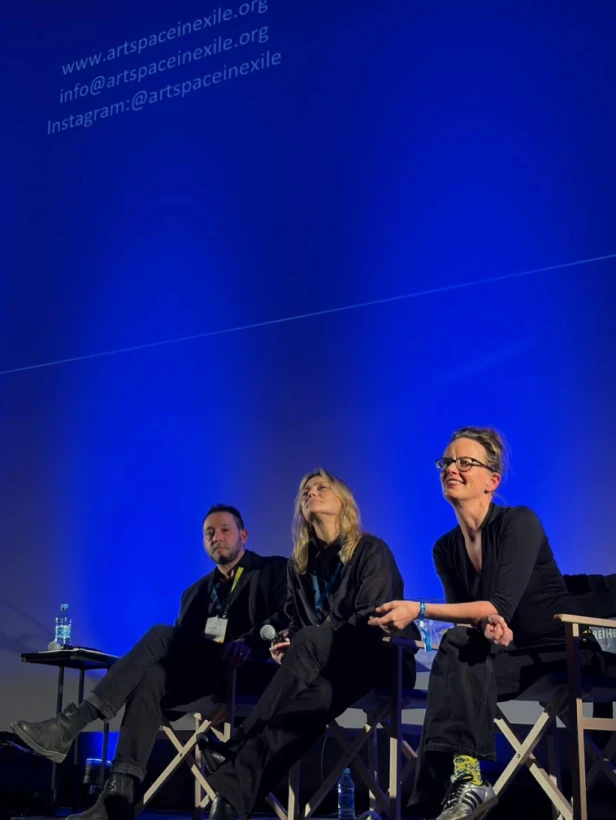
— Could you tell us a bit about yourself? What is your professional and personal background, and how did your journey lead you to creating Art Space in Exile?
Christine: Originally, I am the director of a small independent theatre company in Berlin called theater ogalala. In September 2019, together with my company, I travelled through Ukraine by train to explore a country that had previously been a complete blank spot on the map for us.
During that journey, we met theatre artists who invited us to present a short guest performance at GogolFest in Dnipro. That invitation marked the beginning of a meaningful and productive artistic friendship between us and the curators of GogolFest. Over time, we started working together in different formats, and one of the results of that partnership was two theatre productions I directed with young actors and artists in Mariupol in 2021.
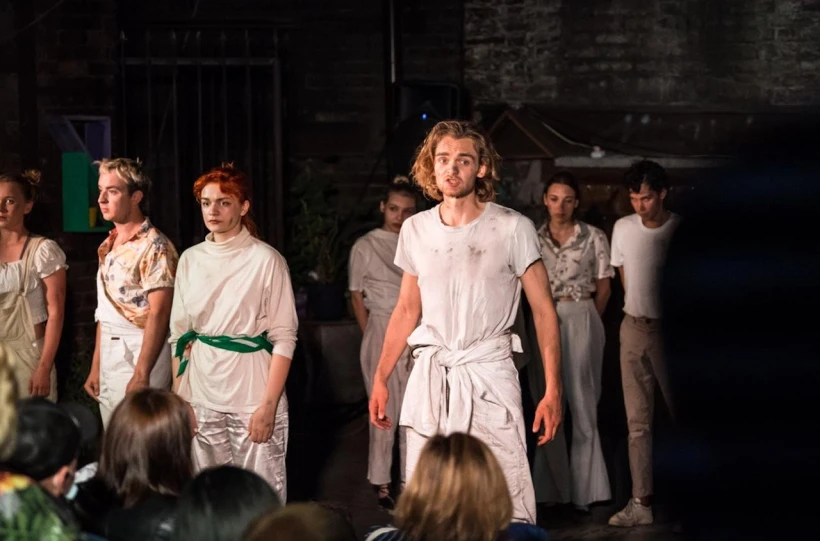
Shortly after my stay in Mariupol, Russia launched its full-scale invasion of Ukraine. At that moment, I felt the need to do more than simply express solidarity in words. I decided to initiate a project that would offer Ukrainians seeking refuge in Berlin a space and a platform to work, connect, and present their art.
That is how Hotel Continental – Art Space in Exile was born. I named it after the independent art centre in Mariupol where my friends and I had worked together.
It was a very spontaneous and unplanned decision. At the time, I had no real experience in cultural management and no idea how many challenges were ahead. We started with a simple pop-up space, without funding and without a clear roadmap. But step by step, together with an incredible team, we built a cultural centre from scratch — with its own gallery, a fully equipped stage, a sound studio, a dance studio, workshop spaces, and even an urban garden.
Today, we curate our own programme, organise festivals, concert series, and residencies, and in many ways have become one of the largest venues for Ukrainian culture outside Ukraine.
— At what moment did the idea of creating a space specifically for artists in exile emerge? Was there a particular experience, event, or personal realization behind it?
Christine:The idea emerged in March 2022, when it became clear that we were facing a much deeper and longer crisis than many had initially imagined — and that Ukrainians would need not only symbolic support, but substantial and long-term support.
For me, the Ukrainian cause is deeply personal. It is personal because my close friends are at war, and because some of my theatre colleagues are serving in the army. But beyond that, I also feel this as a European. I know that our values are at stake in this global rupture.
In that sense, I feel fortunate that I found a way to engage not just emotionally, but practically — to contribute, in however small way, to supporting the right side in this conflict.
— What does the concept of “exile” mean to you?
Christine: Our understanding of the word “exile” has changed significantly over the last four years.
At the beginning, our thinking was very simple: let us offer Ukrainian artists in Berlin a place to work, meet, and spend time together during exile. Later, we considered making exile a broader curatorial theme — one that would include other migrant communities, open wider debates, and connect different displacement experiences.
But over time, we realised that our existing relationships with Ukraine, the composition of our team, which is around 80% Ukrainian, and the historical scale of this crisis required a much clearer focus. That focus became Ukraine, and, more broadly, other Eastern European countries fighting for freedom.
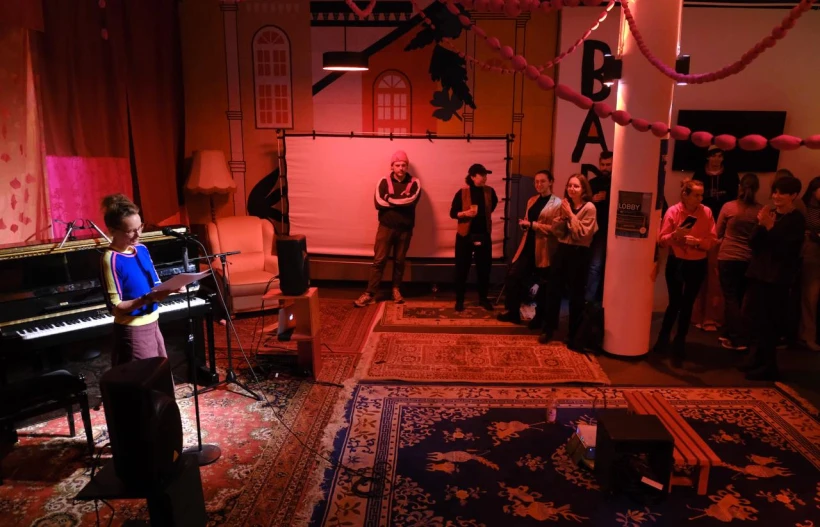
So today, our mission is not only to support relocated people from Ukraine. It is also to build a stable cultural bridge with Ukraine: to invite artists who still live there to Berlin, to create shared projects, and to maintain a strong and living connection with our friends and colleagues in the country.
So if I had to answer directly, I would say this: we still keep our original name, but exile is no longer the main aspect of our work. Or perhaps, in other words, exile has become the new normal. And perhaps even more than that: exile is, of course, difficult, but it can also create an additional burst of energy and creativity in artists — a stronger need for self-expression and for raising one’s voice.
— Why did Berlin become the city for this project? What role does the local context play in the development of the space?
Christine: Berlin is my hometown, so in that sense it became the centre of this project quite organically.
At the same time, it is also a fortunate coincidence that Berlin is home to one of the largest communities of relocated Ukrainians in Germany. That means there is a real community here with whom we can work and for whom this space can matter.
Berlin is also a city that attracts creative people from all over the world. It has a strong artistic infrastructure and a certain openness that makes it possible to initiate new projects and collaborations. For Ukrainian artists in particular, it offers both visibility and opportunity.
To me, it is still astonishing how many talented people have found their way to Berlin. That concentration of creative energy is one of the reasons the space could grow the way it did.
— How has the full-scale war in Ukraine influenced the activities of the space and its overall focus?
Christine: The full-scale invasion was the very reason the project was founded, so in many ways it influenced everything.
It changed my life completely, and naturally it defined the existence of the space from the very beginning.
— What were the biggest challenges you faced during the launch and development of the space?
Christine: There are two major challenges that have followed us almost constantly: the lack of money, and the struggle to preserve enough personal energy to continue, develop, and not burn out.
Everything we do is driven by passion and dedication. People in my team often work extremely long hours. They take on multiple roles at once, while also trying to adapt to a new country, learn a new language, and take care of their families.
That is why maintaining a balance between activism and realism requires constant attention. The emotional and practical demands of this work are enormous, and if you are not careful, the same commitment that keeps a project alive can also exhaust the people behind it.
— Was there a project or an artist’s story that particularly changed or inspired you?
Christine: Over the nearly four years of Hotel Continental’s existence, I have encountered a great many moving and inspiring projects, as well as deeply powerful life stories from the people who came through our space.
In a way, the whole nation of Ukraine — standing against the enemy for more than four years — is a source of enormous inspiration for me. It is a reminder never to give up and never to lose faith.
If I were to mention one specific project, I would highlight the international mural art project “The Wall” by Katya Taylor from Port of Culture in Kyiv. We were fortunate to be part of it, and to me it remains an outstanding example of fruitful collaboration between Ukrainian and international artists.
I also deeply admire the work of Illia Razumeiko and his Nova Opera team. His operas are simply extraordinary.
But above all, my heart is with the many creative individuals inside and outside Ukraine who, despite everything, never stopped composing, painting, writing, filming, photographing, designing, inventing, or making music. Their persistence is what makes the cultural scene of Ukraine today one of the most vibrant in the world.
— How do you see the development of Art Space in Exile over the next three to five years?
Christine: My plan is very clear: to stand with Ukraine until the war is over — and beyond, however long that may take, and of course as long as we are able to secure the financial resources to continue.
The “beyond” is especially important to me. Part of my long-term vision is to bring Hotel Continental — Art Space in Exile back to Ukraine once the situation allows such a move. In that way, I would like to contribute, in however modest a form, to the reconstruction of the country and to create a natural closing chapter for the Berlin story of Art Space in Exile.
In a sense, I would like the project to one day no longer belong to exile.
— What advice would you give to Ukrainian artists who are currently searching for their path outside of Ukraine?
Christine: Artists, almost everywhere, tend to live in precarious conditions, and exile — wherever it happens — rarely makes that easier.
So my advice is very basic, pragmatic, and perhaps even a little boring. But it is honest. Wherever you are, learn the local language — and learn everything else you can. Try to leave the exile bubble as quickly as possible. Be proactive. Look for opportunities. Search for your chances and fight for them.
Those chances do exist. But in most cases, no one will simply place them in front of you. You have to go after them yourself.
Art comes after.